


Tiny board, real planning
A four-by-four grid sounds small until every tile matters. 2048 keeps decisions compact, which is exactly why mistakes feel educational instead of random.
Browser Play
This is a free browser game. We never provide withdrawals, cash rewards, PayPal payments, deposits, or financial account binding.
A compact library of browser puzzles that keep the same low-friction mood without turning the page into a noisy directory.
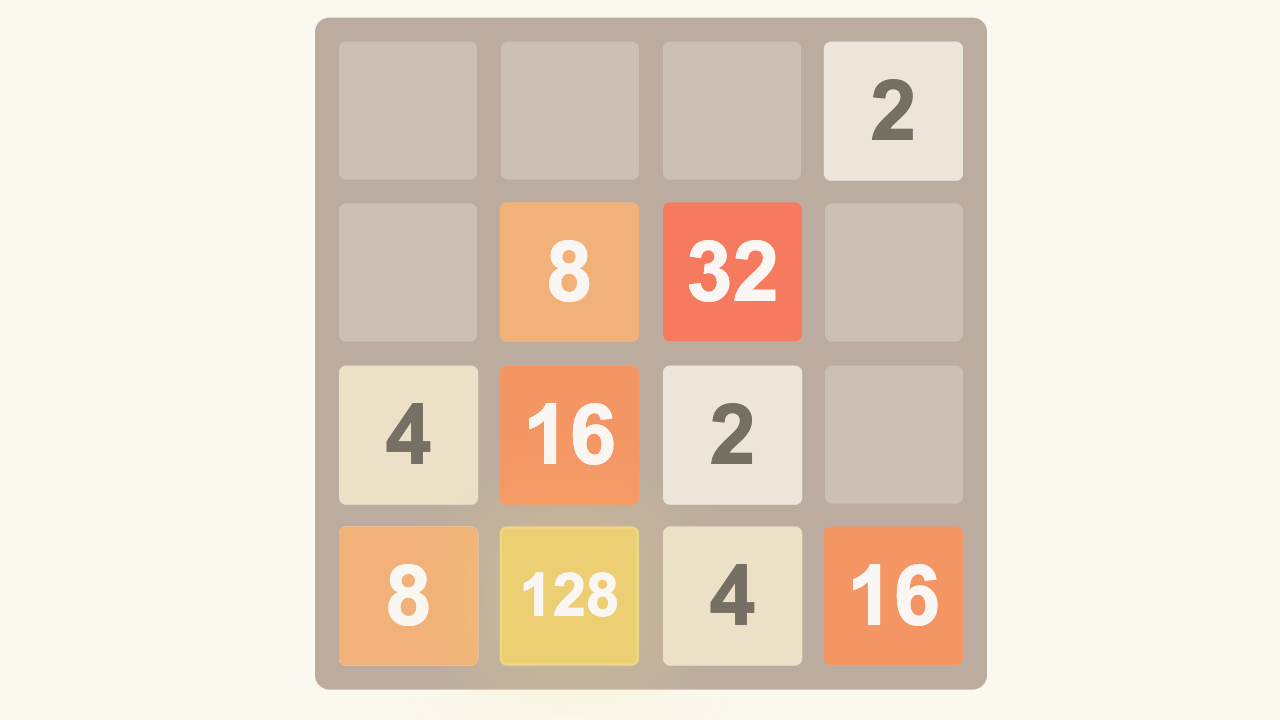
2048 remains compelling because a tiny 4x4 board keeps generating meaningful tradeoffs. The rules are easy to learn in seconds, but the real game is about protecting space, arranging momentum, and deciding when a merge helps the next several turns instead of just the current one.
A four-by-four grid sounds small until every tile matters. 2048 keeps decisions compact, which is exactly why mistakes feel educational instead of random.
The goal is not just making bigger numbers. Strong runs happen when merges keep the board ordered, preserve empty cells, and leave space for the next spawn.
There is no timer forcing the moment. That makes 2048 great for quick breaks, but it also gives serious players room to chase cleaner boards and better scores.
The best beginner advice in 2048 is surprisingly consistent: build structure first, keep your biggest tile anchored, and do not burn space for flashy merges. These notes stay tucked away until you want more depth.
Build structure before you chase the 2048 tile.
Most strong games keep the largest number locked into a corner so every smaller tile can flow toward it instead of constantly reshuffling the board.
Once your big tile is anchored, avoid the move that would pull it away from the corner. Restricting one direction makes the whole board easier to manage.
A good merge does more than make a bigger tile. It should also free space, preserve order, or set up a follow-up merge nearby.
The habits that separate a lucky run from a repeatable one.
The board becomes safer when values taper down from your corner tile. That layout makes future merges easier and reduces the chance of stranded numbers.
The most common way to lose is running out of room. Every move should leave some breathing space so fresh 2s and 4s do not trap your setup.
New spawns add uncertainty, but most losing boards collapse because structure was already fragile. Good planning narrows the damage luck can do.
Keep the extra context available without putting it all in the first glance.
Journal
Classic Puzzle Games Worth Playing Today
Journal
The One Arrow Escape Mistake New Players Actually Make
Journal
Mastering Arrow Escape: Tips & Strategies for Beginners
The primary goal is to create a tile with the number 2048 by sliding and merging tiles. You can continue playing after reaching 2048 if you want to push for larger numbers and a better score.
Yes. 2048 is a free browser puzzle game, so you can play it right away without downloads, installs, or an account wall.
Use the arrow keys or W, A, S, and D on desktop. On phones and tablets, swipe in the direction you want every tile to move.
Reaching 2048 counts as the milestone, but the run can continue. Many players keep going for 4096, 8192, or simply a cleaner final score.
2048 has enough history and mechanical nuance to deserve a second layer of notes. This section keeps the extra background available without forcing it into the first glance.
A few system details explain why careful runs feel so different from messy ones.
After each valid move, the game spawns a fresh 2 or 4. That means every swipe has a cost, even when nothing exciting merges right away.
A tile created by one merge cannot merge again in the same step. Understanding that rule helps you predict which chains are real and which ones only look possible.
The game does not stop once the target tile appears. You can keep refining the board and pushing upward, which is why many players judge a run by shape as much as score.
Because there is no countdown, 2048 rewards measured decisions over reflexes. That slower pacing is part of why the game still works so well in a browser.
The story behind the game still helps explain why it spread so quickly.
Gabriele Cirulli created 2048 in March 2014 as a quick programming experiment. That small origin story became part of the charm almost immediately.
People understood the idea in seconds, shared it instantly, and then got pulled in by how hard it was to stop at one run.
Because the code was released openly, 2048 inspired countless spin-offs, variants, and teaching examples. That openness gave it a long afterlife.
Writers kept describing 2048 as minimalist, frustrating, and addictive in the best way. That combination still captures the experience surprisingly well.